Elements of the semantic web
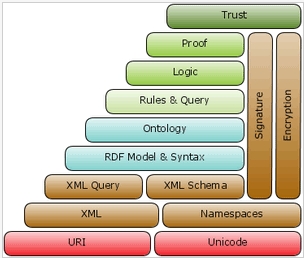
URI (Uniform Resource Identifier) - uniform resource identifier. Use the Web to identify elements. URI can assign any why. This may be a person, book, an abstract concept, ie those entitled.
URI is the basis Web. URI - a character string that identifies any resource: document, image, file, service, e-mail box, etc.
Metadata in the basic model of semantic "Web" is obviously not highlighted. However, states that the emphasis is on the concept of metadata.
Metadata is structured data that represent characteristics of the described entities to their identification, search, evaluation, and management.
There have been many schemes developed metadata description, including the following should be noted:
Topic Maps (XMT) - a form of knowledge representation with a focus on improving information retrieval.
Text Encoding Initiative (TEI) - an international project to develop standards for marking electronic texts such as novels, mainly to support research in the humanitarian sphere.
Encoded Archival Description (EAD) - encoded archival description, developed as a way of marking the data contained in the search engines, so that they were also displayed on-line.
Metadata Encoding and Transmission Standard (METS) - standard for encoding and transmitting metadata, was designed to meet the need for standard data structure for describing complex digital library objects.
The base for the semantic "Web" is currently recognized standards Dublin Core, FOAF, SIOC and DOAP.
FOAF (Friend-Of-A-Friend) - a machine-processable format pages that describe personal information about people and their work (photos, calendars, blogs, etc.) in XML.
SIOC (Semantically-Interlinked Online Communities) - documents that describe the online community. SIOC provides a discussion of the relationship of such information as blogs, forums and mailing lists with each other.
Description of a Project Description of a Project (DOAP) - documents describing the Internet projects with open source.
Dublin Core - a set of elements (properties) for describing documents, which promotes description and automatic indexing dokumentopodibnyh network objects on principle, like a card catalog cards.
Dublin Core metadata set intended for use by the research Internet resources such as web-kroulery search engines. Also expected to Dublin Core is a set of easy enough to understand and use a wide range of authors and publishers of casual, placing information on the Internet. Elements of the standard Dublin Core is widely used in documenting Internet resources.
Metadata can be embedded in the very web-pecypc, for example, HTML pages or documents may also be stored and updated independently of resources. Many software manufacturers have already produced a number of products that will automatically form a small block of RDF-descriptions within the document. The second approach is more universal, because in this case, the metadata can be created for any resource. Currently the project has already begun based on Open Directory (search engine Google) to automatically store RDF-descriptions of Internet resources.
In the case of a metadata separately from the resource, most preferably metadata are stored (and transmitted) in XML. It features the most used model of RDF and the free exchange of information. Sharing metadata comes to sending RDF / XML-files (ie text files in XML or simply links to the files), that can be fully automated.
Options following XML:
presentation syntax for other markup languages;
semantic markup of Web-pages.
XML language allows everyone to create their own document format and then develop documents in this format. These document formats may include markings to clarify the content of the document content. Document layout can "read" computer.
To describe the domain resources using standard RDF (Resource Description Framework), adopted in 1999, the W3C and supported by many leading software manufacturers and content providers. The initial appointment was in RDF XML-description of resources from different perspectives. RDF is a model of metadata description. This language uses XML-syntax.
Standard RDF consists of two main parts - the actual way to describe resources and how the task of schemes, which describes the resource.
The first part of RDF defines a simple model to describe the object that is seen as a resource, as ties between resources in terms to named properties and values. The second (RDF Schema - RDFS). serves to structure the task domain and similar diagrams of classes in UML.
In the RDF can be described as the resource and the associated subject area.
The basic building block in RDF - a trio of "object - attribute - value" who often write as A (O, V), ie the object O has attribute A with value V. This connection can also be represented as an edge labeled A, which combines two components, O and V: [O]. - A -> [V]. This notation is useful because RDF allows objects and swap values. Thus, every object can play the role of the value that corresponds to a graphic conversation with two edges labeled
Besides all the above, RDF allows the way in which any expression of the three can be the object or value, that graphs can be nested, and linear. On the Web this allows, for example, to express doubt or agreement with the expressions created by other people.
The main purpose of RDF - the basic model to offer data object - attribute - value "for the metadata.
Thus, RDF allows you to formulate the statement in a form suitable for computer processing, which is the basis of semantic "web».
The first "reservoir" semantic "Web" on the syntax is a simple model Data Typing. Scheme and ontology - a means to describe the content and the relationship between terms.
RDF Schema is a working draft of RDF Vocabulary Description Language 1.0 based on RDF which was introduced January 23, 2003. RDF scheme was designed as a simple model Data Typing for RDF. As indicated in the document, RDF is the language of general application to submit information on the Internet. This specification describes how to use RDF to describe RDF-dictionaries. It defines a basic vocabulary for this purpose and approved the agreement, which can be used to create applications semantic "web" to support more complex vocabularies RDF-descriptions. RDF vocabulary description language defines classes and properties that can be used to describe other classes and properties, and make some more complex things such as creating ranges and ranges for properties.
Three most important thing that gives us RDF schema and RDF - a "Resource» (rdfs: Resource), «Class» (rdfs: Class) and "Property» (rdfs: Property). This concept is a "class" in the sense that these classes may include terms. As mentioned above, RDF Schema is defined in terms of basic information model of RDF - the structure of the graph that describes the resources and properties. All dictionaries RDF using some basic structure: they describe classes of resources and types of relationships between resources. This commonality allows the use of diverse vocabularies created for machining, and meets the requirements for creating metadata in which statements may be obtained from a variety of heterogeneous decentralized vocabularies created by different communities on different principles and different methods.
Description of using RDF is not limited to documents describing the Internet. This standard is flexible and versatile enough to describe most types of structured data. For example, naturally expressed in RDF entity-relationship diagrams, which are widely used for database design. Description of the semantics of RDF resource may be "outside" when the resource is described in general, and "internal", when described the internal structure of a resource - be it a database, XML-document, or the whole site.
An important feature of the standard RDF, like that underlying XML, is expandability. In the RDF can specify the structure of source descriptions, using and expanding the concept of RDF-built circuits, such as classes, properties, types, collections. RDF schema model includes inheritance, may have inherited as classes and properties.
In addition to describing the structure, RDF allows the management representation. The term "resource property as R1 R has the resource R2» can be interpreted as a predicate P (Rl, R2), and then use this statement as an object of other statements. This interpretation allows to describe using RDF conceptual information. Thus, RDF is quite appropriate to be the universal language of description of semantics resources and links between them.
However, as the authors claim the standard, RDF also has a number of missing properties:
power failure guidelines set property values, for example, that "Man has only one biological father»;
failure indication is given that the property (for example, hasAncestor - has an ancestor, the prototype) is transitive, for example, that "if A hasAncestor B, and C hasAncestor C, then A hasAncestor C»;
inability to indicate that two different classes, defined in different schemes actually represent the same concept;
inability to indicate that two different copies (instances), set apart, effectively representing a single entity and the largest;
inability to identify new classes in terms of operations (eg union and intersection) over other classes.
Ontology is defined as shared formal concepts of specific subject areas, they give an overview of the concept with which people can exchange and applications. They allow recording conceptualize domain entities and relations in the domain. Note that relations involved can understand the essence part and its importance since it allows you to see where this is the essence of a relationship with other domain.
Layout documents semantic "Web" using ontological terms will perform automatic processing of their content. Thus, ontology is defined as a key technology for the development of semantic "web»
Ontology can play a critical role in the organization for knowledge-based Web, their general use and sharing between applications.
Language DAML (DARPA Agent Markup Language), designed by Defense Advanced Research Projects (Defense Advanced Research Projects Agency) as an extension of XML and RDF. The latest version of the language DAML OIL provides a wide range of structures to create ontologies and markup information so that their computers were able to read and understand.
DAML OIL is a semantic markup language for Web-resources. It provides modeling primitives that are commonly used in languages based on frames. Ontology DAML OIL (or knowledge base, knowledge base) is a collection of RDF - triples. An ontology usually contains a hierarchy of domain concepts and describe the important properties of each concept with the help of "attribute - value. Relationships between concepts can be described with additional logic statements.
Language OWL. The most advanced language for representing ontologies is now OWL (Web Ontology Language), which enhances the XML, RDF, and RDF Schema. This language is based on DAML OIL.
OWL ontology is a sequence of axioms and facts from the addition of references to other ontologies that are considered included in the ontology. OWL Web Ontology is a Web-document and they can refer. The ontologies are also not associated with the logic component (not yet specified) that can be used to record authorship and other unrelated information to the logic associated with an ontology. In fact, this dictionary, which extends the set of terms defined in RDFS.
